
Legacy
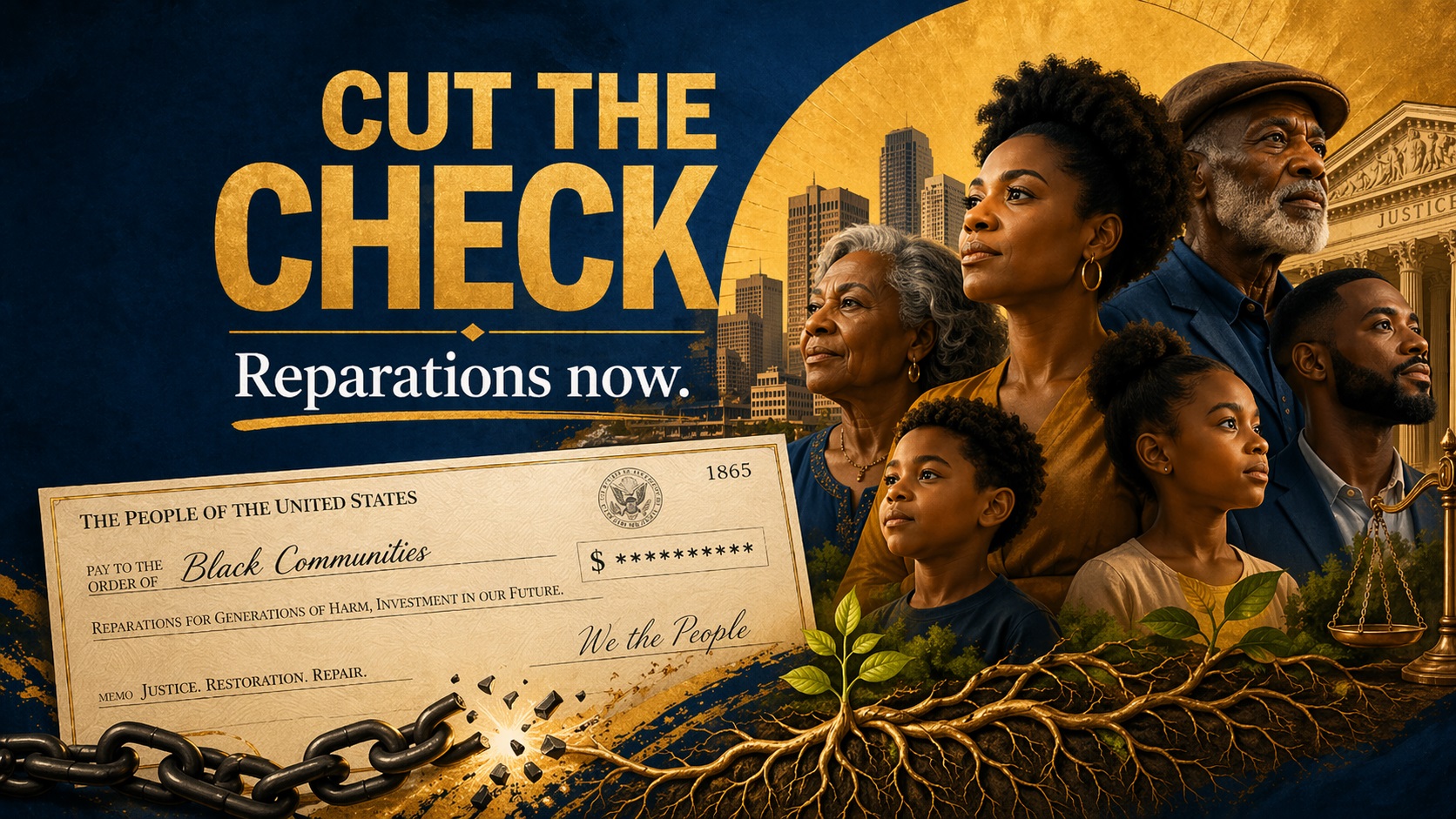
The Case for Reparations Is Settled.
The Time for Action Is Now.
Something has shifted
Not long ago, reparations for Black Americans were easy to dismiss. Politicians ignored the idea. Media treated it as a fringe position. Critics called it unrealistic, divisive, too complicated, too expensive — anything to avoid engaging with it seriously.
That era is over.
Local governments have launched reparations programs. State task forces have released detailed policy reports. Federal legislation has kept the conversation alive in Washington. The moral argument has been made, backed by history, backed by data, backed by decades of scholarship. What remains is not a question of justification. The harm is documented. The case is made. The question now is whether the United States has the courage to act on what it already knows.
Why cash — and why first
For many advocates, one principle sits at the center of this movement and cannot be bargained away: direct cash payments to descendants of American chattel slavery.
Not monuments. Not museum funding. Not another commission. Cash — because the injury was primarily, among other things, an economic one. Generations of stolen labor. Blocked inheritance. Systematic exclusion from the wealth-building tools — homeownership, business loans, education, land — that other Americans used to secure their futures. A material harm of that scale demands a material remedy.
Cash also carries a form of respect that other approaches don't. It treats Black Americans as capable adults who understand their own needs. One family might use a payment to stabilize housing. Another might clear debt, start a business, or create educational opportunity for the next generation. That flexibility is not a flaw in the policy — it's the point. The losses touched every part of life, and the remedy should be equally broad.
The study phase is over
One of the most persistent tactics used to delay reparations is the call for more study. Another commission. Another report. Another round of hearings to determine what we already know.
But the record is not incomplete. Historians, economists, legal scholars, and policy researchers have spent years — decades — documenting the injury and modeling the remedy. We know who was harmed. We know how that harm compounded across generations. We know how it continues to shape the economic lives of Black families today. The research exists. The evidence is in.
Calling for more study at this stage is not caution. It is postponement dressed up as process. And for a country that has been postponing this question since Reconstruction, another delay is not a neutral act — it is a choice.
The government knows how to move when it wants to
There is a particular frustration that runs through the reparations movement, and it is worth naming directly. When the federal government decides something is urgent, it acts. It has demonstrated, repeatedly, that it can identify populations, build administrative frameworks, and direct resources at speed.
That same capacity has not been applied to Black Americans whose claims rest on centuries of documented, state-sanctioned exploitation. Instead, they are told to wait. To prove. To study more. To negotiate down. To narrow the ask. And then to wait again.
At some point, regardless of politcal party, a pattern of delay stops looking like caution and starts looking like refusal.
Keep the claim clear
One of the movement's strengths is the specificity of its core demand: cash reparations for descendants of American chattel slavery. That clarity is worth protecting.
Reparations are not a rebranded anti-poverty program. They are not a catchall for every contemporary inequality. They are a targeted remedy for a specific historical wrong inflicted on a specific population — and any serious policy must be anchored there. Broadening the claim until it becomes unrecognizable is not compromise. It is dilution.
The eligibility standard should stay focused, because the injustice was focused. The remedy should match the wrong.
What the path forward looks like
The priorities are straightforward, even if achieving them is not.
Cash-first reparations must remain the center of the demand — not a starting position to be traded away, but the actual goal. Eligibility should stay specific: descendants of American chattel slavery. The existing body of research should be used aggressively, so opponents cannot endlessly restart the clock with calls for fresh study.
State and local programs matter and should be celebrated — but they are not the finish line. The injury was national. The remedy must ultimately be national as well.
And the movement should speak with confidence, because its case is strong. Reparations are not charity. They are not a radical ask. They are an attempt to make American principles mean what they say.
The danger now is not defeat — it's delay
The reparations movement has survived generations of ridicule and emerged as a genuine policy question. That is a real achievement. But the risk has shifted. The new threat is not outright rejection. It is being absorbed into an endless process — more committees, more reports, more dialogue — just as material demands are within reach.
America has had enough time to think about this. The record is clear, the case is made, and the tools to act exist. What has always been missing is political will.
Reparations will not come on its own, and it is not a hat-in-hand request. It is not a favor.
It is an invoice - a demand for what is owed.
References
Foundational Historical & Economic Analysis
- Ta-Nehisi Coates (2014), The Case for Reparations — The Atlantic — Source website
- William A. Darity Jr. & A. Kirsten Mullen (2020), From Here to Equality: Reparations for Black Americans in the Twenty-First Century — University of North Carolina Press
- Thomas Craemer (2015), Estimating Slavery Reparations: Present Value Comparisons of Historical Multigenerational Reparations Policies — Social Science Quarterly
Wealth Gap & Economic Harm
- Federal Reserve (2019), Survey of Consumer Finances — Source website
- Brookings Institution (2020), The Black-White Wealth Gap Left Black Households More Vulnerable — Source website
- McKinsey & Company (2021), The Economic Impact of Closing the Racial Wealth Gap — Source website
Legal & Policy Frameworks
- U.S. Congress (ongoing), H.R. 40 – Commission to Study and Develop Reparation Proposals for African Americans — Source website
- California Reparations Task Force (2023), Final Report — Source website
- National African American Reparations Commission (2015), Preliminary Reparations Program for People of African Descent in the United States
State & Local Reparations Efforts
- City of Evanston (2021), Local Reparations Program (Housing Grants) — Source website
- City of San Francisco (2023), African American Reparations Advisory Committee Report
Scholarly & Moral Framework
- United Nations (2021), Report of the Working Group of Experts on People of African Descent
- American Economic Association, Various papers on racial inequality and intergenerational wealth